Miracles News
Articles by
Pathways of Light Ministers
Subscribe to printed version of Miracles News.
Most Recent Articles
(Drag to scroll down.)
- Miracles News, May–Aug., 2026
- Remembering the Dreamer
- They Are My Classroom, Not My Problem
- The Peace of Not Knowing
- The Desire for Lucid Living
- The Control Issue
- From the Garbage Heap to Awakening
- Silent Miracles
- Choosing Love Not Fear
- Healing the Heartbreak: ACIM Principles in Today’s World
- The Gratitude the Ego Cannot Fake
- Healing My Apprehensions
- Windows and Mirrors
- Taking the Time to Receive God’s Peace and Happiness
- Thank You Beloved Guide Holy Spirit
- Standing on Holy Ground
- The Empty Chair: Why My “Knowing” Almost Killed Me
- Miracles News, Jan.-Apr., 2026
Archives
Miracles News,
May-August, 2026
Choosing Love Not Fear
 Three years ago, my first grandson was born. His arrival brought profound joy and hastened my decision to retire. When I retired, my primary goal was to devote myself to studying A Course In Miracles, believing that the right next steps would follow, including spending time with my family.
When my own children were born, I was, at first, still working in the financial world. It was very hectic and intense. By the time my second child was born, my husband and I had decided that I would stay home with the children. I did stay home; then, my husband and I split up. Suddenly, I was a single mother entrusted with the sole custody of my small children.
I managed to stay home with them for five years, exhausting my savings. It was an emotionally challenging time, but I loved being a full-time mom. It was during this time that I came across A Course In Miracles. I studied as though my life depended on it. The Holy Spirit gently guided me through dark times. Light is obvious when it is so dark!
Several decades have passed. Jesus held my hand and the Holy Spirit provided for my little family by gently awakening my mind to my true reality. As I retired, I felt the tug of regret that I hadn’t been able to be more relaxed with my children.
I had been impatient, short-tempered and filled with fear. Ego things, for sure, but my awareness of my mistakes made it possible for me to take them to the Holy Spirit for healing.
My sons have grown into adults, and the impact of their childhood experience is something I cannot change. Our relationship has been a powerful classroom. Turning everything over to the Holy Spirit for correction as I become aware of it and following His guidance, not substituting my own plan for His, is what I am committed to doing. In this context, my grandson’s arrival has been a beautiful gift. I have been able to observe when little ones start to exhibit shame, guilt, anger (frustration, really), joy, and trust. I ask the Holy Spirit to guide my relationship with him — and with his newly arrived baby brother.
Recently, my grandson, now three, stayed with me for several nights. I live on my own with a ferocious cat. I was a little concerned about my ability to manage his rambunctious energy so that he would be safe. On the second night, in getting ready for bed, he wanted to jump on my bed and from there to his own bed on the floor. This was not going to be safe.
A gentle request for him to stop jumping didn’t work. I had to raise my voice. He heard me and burst into tears saying, “Gigi is angry with me.”
I was heart sick. I asked the Holy Spirit for guidance. He gave me these words: “I am never angry with you. I can never be angry with you. It is impossible. I love you. When Gigi raises her voice, she is afraid that you will hurt yourself.” I heard the conclusion: I was not angry; I was afraid. I can choose love. I chose love. My grandson, still crying, looked at me. There seemed to be no barrier between us. I said, “I love you. I can never be angry with you. I will tell you when I am afraid and we will figure out what to do next.”
I felt him snuggle into me. Then, I felt us being enveloped by a Love so vast and beautiful that it stretched outward and inward beyond all boundaries. The oneness that we are with All was palpable. As the soft, gentle light wrapped around us, my grandson fell deeply asleep. I was so very grateful for the experience.
I imagine that there will be many more times when I must correct my grandson firmly. I imagine that he will feel shame and sorrow as a result, but I must remember that when I see ‘shame’ and ‘guilt’ in him, I must choose differently.
I must choose to see the shining presence of Love in his mind, shared with mine. This doesn’t mean that I won’t teach him about how to navigate the dream world of safety, boundaries, nutrition etc. I will. But the only lesson that I am here to teach him is to be in my right mind — an example of how to choose peace, to choose Love. In my right mind, I see him as he is — in his right mind with me even as a little child.
I learned another lesson that night: I can take everything to the Holy Spirit and He will, in the quiet of my mind, give me the words to say and show me what actions to take. The result is the profound peace of Love. My beautiful grandson is healed as I am healed. We are healed together. What a gorgeous lesson in forgiveness!
Rev. Joanne Goodrich, OMC, is a Pathways of Light Spiritual Relationship Counselor living in Burlington, Ontario, Canada. Email:
.(JavaScript must be enabled to view this email address)
© 2026, Pathways of Light. https://www.pathwaysoflight.org
You may freely share copies of this with your friends, provided this notice and website address are included.
Miracles News,
May-August, 2026
Healing the Heartbreak: ACIM Principles in Today’s World
 In a world rife with division and turmoil, many of us feel a profound heartbreak as the very foundations of our belief systems begin to crumble. Labels, ideologies, and the identities we once clung to are dissolving, revealing an opportunity for healing and transformation. As A Course in Miracles teaches, “Nothing real can be threatened. Nothing unreal exists.” (T-IN.2:2-3) This profound insight invites us to look beyond surface chaos and embrace a deeper truth.
The current political climate reflects stark divisions among individuals, communities, and nations. Ideological battles rage as people cling to their beliefs, often forgetting the thread of shared humanity that binds us all. In these tumultuous times, ACIM’s teachings remind us of the power of forgiveness and unity, asserting that forgiveness offers everything I see a purpose; I can choose to look upon the world with love instead of fear. This call to forgiveness invites us to step away from the judgment and condemnation that fuels conflict. Instead of viewing those who oppose us as enemies, we are encouraged to recognize them as fellow travelers on the journey of life — children of the same Source, deserving of love and understanding.
The emotional toll of living in such a polarized world can lead to intense feelings of grief and despair. From individual losses to collective struggles, the pain is palpable. Yet ACIM offers a perspective that can transform suffering into healing: All pain comes from a selfish mind. All suffering is a call for love.
When we experience heartbreak, it serves as a reminder to turn inward and examine our thoughts and reactions. Instead of allowing ourselves to be consumed by fear and despair, we have the opportunity to choose Love. Grieving is a natural response to loss, and when approached through the lens of ACIM’s teachings, it can become a powerful catalyst for healing.
As belief systems collapse, many individuals cling to labels that define their identities — political party, religion, nationality, and more. These labels often become sources of division, leading to conflict and misunderstanding. ACIM encourages us to release these attachments, reminding us that “To give and receive are one in truth.” (W-108)
By letting go of rigid identities and recognizing our shared humanity, we can foster connection rather than fragmentation. This process involves questioning our beliefs and discovering what lies beneath — values of compassion, Love, and understanding that transcend superficial differences.
In times of chaos, the teachings of ACIM guide us toward embracing unity. We are reminded that, “Miracles are a kind of exchange. Like all expressions of love, which are always miraculous in the true sense….” (T-1.I.9:1) This unity is not merely an abstract notion but a call to action, urging us to express Love in our daily lives.
Embracing ACIM principles allows us to take personal responsibility for our thoughts and actions. Instead of contributing to cycles of division and pain, we can choose to be channels of Love and healing. It is through our interactions and relationships that miracles unfold, transforming not only ourselves but also the world around us.
As we navigate the heartbreak and confusion of our world, let us remember the wisdom of A Course in Miracles. By releasing our attachments to labels and embracing our interconnectedness, we can cultivate a path of healing and Love. Through forgiveness, we can transform not only ourselves but also the world around us — creating miracles where once there was only chaos.
In this time of upheaval, may we choose to rise above fear, embracing the Love that binds us all. Let us be the change we wish to see, embodying the principles of ACIM in every facet of our lives. Together, we can heal the heartbreak and create a new paradigm grounded in Love and unity.
Maureen L. Yarbrough, OMC, is a Pathways of Light minister living in Rochester, NY. Email: .(JavaScript must be enabled to view this email address)
© 2026, Pathways of Light. https://www.pathwaysoflight.org
You may freely share copies of this with your friends, provided this notice and website address are included.
Miracles News,
May-August, 2026
The Gratitude the Ego Cannot Fake
 On Receiving Everything — Not Just the Things We Like
I did not arrive at gratitude through sunsets or morning practices or lists written beside a cup of tea. I arrived at it through resentment. Through shame. Through the ordinary moments in which life refused to arrange itself in ways that made me feel secure, seen, or successful — and through the uncomfortable discovery that every form of gratitude I knew vanished the moment circumstances stopped cooperating.
There is a version of gratitude most of us recognize. It appears when things go well: When the health report comes back clear, when the relationship feels stable, when the coffee tastes right, and the future seems manageable. This gratitude is sincere, but it is also selective. It is approval disguised as spirituality — the ego quietly sorting experiences and placing a tick beside what it prefers.
“I am grateful,” it says, meaning: Life is behaving as I hoped. And when life stops behaving that way, the gratitude disappears just as quickly as it came. What I want to describe here is a different kind of gratitude altogether. One that does not wait for life to improve before it appears. One that can arise precisely in the places the ego most wants to condemn.
The Gratitude That Fails When We Need It Most
The ego operates as a sorting machine. This is pleasant. This is painful. Keep this. Remove that. Even its gratitude is conditional. It thanks life when life cooperates. Which means the gratitude most of us practice works only under favourable conditions — precisely when we need it least.
When something genuinely unwanted arrives — a diagnosis, a loss, humiliation, rejection, or the quiet ache of feeling unseen — gratitude suddenly feels artificial. Forced gratitude feels worse than no gratitude at all, because something in us recognizes the dishonesty.
The shift for me began with a distinction made in A Course in Miracles: The difference between looking and judging. Judging is what happens when we give meaning to experience — when we attach interpretation to what appears: This is good. This is bad. This means something about me. Looking is encountering the same experience without adding a story. Nothing changes externally. Only the mind’s activity changes.
That simple distinction turned out to be the difference between a gratitude that collapses under pressure and one that remains when nothing improves. I recognized this not through theory, but one ordinary afternoon.
A Café, a Plumber, and a Dead Honeysuckle Bush
A few years ago my boiler was being replaced, and a plumber had effectively taken over my house for the day. I escaped to a café with a book by Ken Wapnick on overeating — a subject that carried more quiet shame for me than I liked to admit. The book described compulsive behaviour not as weakness, but as defense: The ego attempting to cover fear it does not want exposed. Reading it, something shifted. The overeating was no longer a problem to fix or a failure to manage. It was revealing something. It was showing me a block in my mind.
Suddenly I felt gratitude. Not gratitude that the problem existed, but gratitude because the problem made the block visible. What I had condemned for years as evidence against me became evidence for healing. Without the symptom, the underlying belief would have remained hidden. The very thing I had wished away was the thing showing me where forgiveness was needed.
Nothing about the behavior had changed. The struggle was still present. But its meaning transformed completely — and with it, my relationship to myself. The shame loosened. In its place came something quieter than relief: A peace that did not depend on improvement, only on willingness to see.
Moments later my phone rang. The plumber explained he had needed access up the side of the house and had cut down a dead honeysuckle bush blocking the path. Was that alright? I laughed out loud. I had been trying for months to remove that bush. Every quote had been too expensive. It had simply remained — dead, obstructive, mildly irritating. And now it was gone. Effortlessly. Without cost. Without struggle. You may call it coincidence. I do. But I noticed something: When resistance relaxed, even briefly, life seemed to move without obstruction — as though the mind’s grip and the world’s resistance had never been separate things at all.
Looking Without Judging
A Course in Miracles uses the metaphor of a dream. When you forget you are dreaming, everything within the dream appears consequential. Threat frightens you. Pleasure reassures you. The dream dictates your emotional life because you have granted it reality. But once you recognize the dream as a dream, nothing within it can truly disturb you. The scenes continue. You still participate. Yet something fundamental has changed: You are no longer judging what you see as defining you.
Looking without judging functions in the same way. The content of experience may remain exactly as it was, but its authority dissolves when meaning is withdrawn. Gratitude, in this deeper sense, is not a practice we perform. It is what remains when condemnation ends.
The Grievance I Wanted to Keep
The second moment that clarified this was less charming. I attended a workshop led by an ACIM teacher I respected enormously. At some point I noticed he seemed to give more attention to others than to me. The resentment appeared instantly. I had made the effort to be there. I wanted acknowledgement. The ego assembled its case with impressive efficiency — and, if I am honest, I did not want to release it. The grievance felt justified. Protective. almost necessary.
My mind rehearsed arguments, replayed interactions, gathered evidence. Being overlooked felt personal, meaningful, real. Eventually I stopped trying to fix the feeling and simply looked at it. Not suppressing it. Not spiritualizing it. Just noticing the interpretation I had attached. The belief revealed itself plainly: I thought I needed recognition in order to be at peace. The teacher had not created that belief. He had exposed it. Seeing this was uncomfortable — and deeply relieving.
Again, gratitude appeared. Not because the situation improved, but because a hidden block had become visible. The resentment had been a teacher, pointing precisely to where I still sought validation from the world. The moment the grievance lost its purpose, something softened. The distance I had perceived disappeared. This teacher became a close friend and has remained one.
To Forgive Is to Make Holy
Proust’s painter Elstir tells the young Marcel that no wise person has escaped the ridiculous or odious incarnations that precede wisdom — and that they should not be regretted, because they were the path. It is a generous idea. But it is still essentially backward-looking: The past redeemed in hindsight, the wound accepted after it has healed.
What A Course in Miracles points to is something more immediate and more radical. Not the forgiveness that makes peace with what we once were, but the forgiveness that transforms what is here now.
“The holiest of all the spots on earth is where an ancient hatred has become a present love. And They come quickly to the living temple, where a home for Them has been set up. There is no place in Heaven holier. And They have come to dwell within the temple offered Them, to be Their resting place as well as yours. What hatred has released to love becomes the brightest light in Heaven’s radiance. And all the lights in Heaven brighter grow, in gratitude for what has been restored.” (T-26.IX.6)
Hatred is not neutralised. It is not managed or resolved or put away. It is transmuted into the brightest available light. The ancient grievance, forgiven, becomes holier than anything that was never a grievance at all.
My relationship with that teacher could only become what it became because he pulled from me a small but real hatred — and I forgave it. The Course makes no distinction in truth between a tiny irritation and a murderous rage. Both are the same block, scaled differently. The content is identical; only the intensity varies. This means those who provoke us most are not our most difficult relationships. They are our holiest ones in potential. Every grievance is an invitation. Every irritation, however minor, is the raw material of a temple.
Proust understood that the odious incarnations were necessary. The Course goes further: They were not just necessary. Forgiven, they become luminous. To forgive is not to excuse. It is not to manage or minimise or forget. It is to make holy.
Nothing Is Unusable
There is a line from Paul’s letter to the Romans that returns to me often: All things work together for good. The ego cannot accept this. Its identity depends on dividing experience into gain and loss, success and failure, approval and rejection. If everything can serve healing, the ego’s role as judge becomes unnecessary — and it will resist that conclusion fiercely.
This does not mean events themselves are good. Pain still hurts. Loss still grieves. It means nothing is unusable. Illness, addiction, embarrassment, resentment — each can reveal the mistaken beliefs the mind has been protecting. The symptom points to the block. The block, once seen, can be forgiven. And what is forgiven becomes, in the language of the Course, the brightest light.
Nothing needs to be excluded from healing. Nothing needs to be excluded from gratitude. This is not passive acceptance. It does not deny feeling. In both stories, the emotions were real and fully experienced. What changed was not the feeling but the refusal to turn feeling into a verdict. The ego uses feeling as evidence. Forgiveness allows feeling without condemnation.
The Gratitude the Ego Cannot Fake
Overeating remains part of my learning. The honeysuckle bush is gone. The teacher is a friend.
None of that is the point. The point is a moment when something long condemned revealed itself as a doorway instead. When shame became instruction. When a small grievance, looked at honestly and released, became the foundation of one of the closest relationships in my life. What I had wanted to abolish became what made healing possible.
This is the gratitude the ego cannot fake, because the ego cannot survive it. It requires the willingness to look at exactly what we most want to condemn — in our circumstances, in others, in ourselves — and to recognize it not as evidence against us, but as the place where the light gets in. The Course calls it the holiest spot on earth: “Where an ancient hatred has become a present love.”
Gratitude of this kind is not a feeling we cultivate. It is what arises when we stop fighting what is here — and see, perhaps for the first time, that it was never the obstacle. Not gratitude for pleasant outcomes. Not gratitude in spite of difficulty. Gratitude for whatever reveals the block — because the moment the mind is willing to see, the work of healing has already begun. And what hatred releases to Love becomes, in ways the ego cannot measure, the brightest Light available.
Kirsty Randle is a Pathways of Light minister living in Dorset, 2UK. Email: .(JavaScript must be enabled to view this email address).
© 2026, Pathways of Light. https://www.pathwaysoflight.org
You may freely share copies of this with your friends, provided this notice and website address are included.
Miracles News,
May-August, 2026
Healing My Apprehensions
 With the current wars and the release of the Epstein files I was feeling very sad.
There was a constant aching in my heart for the innocent children and all the people caught in the middle. I was holding grudges and casting blame. I prayed for guidance.
I was guided to look on the Pathways of Light website and read a post I had sent a number of years ago. These are the words that really stood out to me in the post I read referencing lesson 193:
“To all that speaks of terror, answer thus: I will forgive, and this will disappear.
To every apprehension, every care and every form of suffering, repeat these selfsame words.
And then you hold the key that opens Heaven’s gate, and brings the Love of God the Father down to earth at last, to raise it up to Heaven. God will take this final step Himself. Do not deny the little steps He asks you take to Him.” (W-193.13:2-7)
I practiced this advice and my judgments against my brothers have stopped. I am feeling more peaceful and I now have hope. I am very grateful for the opportunity to share this experience with you and the profound effect that practicing forgiveness has had on healing my mind.
Rev. Tarra Bennett, O.M.C., is a Pathways of Light minister living in Grand Beach, Newfoundland, Canada.
Email:tarrabennett@gmail.com Website: http://www.healingfromwith.ca
© 2026, Pathways of Light. https://www.pathwaysoflight.org
You may freely share copies of this with your friends, provided this notice and website address are included.
Back to main page of Miracles News.

How to Read References for
Quotes from A Course in Miracles
Below are example references to specific sentences using the notation of the Second & Third Editions of A Course in Miracles published by the Foundation for Inner Peace:
T-26.IV.4:7 = Text, Chapt. 26, Section IV, paragraph 4, sentence 7.
W-169.5:2 = Workbook, Lesson 169, paragraph 5, sentence 2.
W-pII.1.1:1 = Workbook, Part II, Question 1, paragraph 1, sentence 1.
M-13.3:2 = Manual for Teachers, Question 13, paragraph 3, sentence 2.
C-6.4:6 = Clarification of Terms, Term 6, paragraph 4, sentence 6
The above numbering system of the Second & Third Editions published by The Foundation for A Course in Miracles
Featured Store Items
 Spiritual Counselor Training — based on principles of A Course in Miracles, including ordination. More….
 24 ACIM Practitioner courses including 50-page study guide, CD's or MP3s, with facilitator. More….
 Healing Inner Child 8-week program will help you nurture your inner child, connect with your Higher Self and heal relationships.
 Listen & Receive 30-Day Home Study Learn to receive
insight for your life in a form that is perfect for you …heal fears, find joy & peace.
Learn more.
Listen & Receive 30-Day Home Study Learn to receive
insight for your life in a form that is perfect for you …heal fears, find joy & peace.
Learn more.
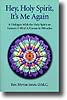 Hey, Holy Spirit, It's Me Again by Rev. Myron Jones. An indispensible guide for anyone on the path of ACIM with insights on the 1st 90 lessons. More…
 True Forgiveness by Rev. Jennifer McSween. The Proven Path from Pain to Power and personal happiness in 5 Simple Steps.
Learn more.
True Forgiveness by Rev. Jennifer McSween. The Proven Path from Pain to Power and personal happiness in 5 Simple Steps.
Learn more.
 From the Christ Mind Book II scribed by Darrell Morley Price. A great supporting supplement to A Course in Miracles. We highly recommend it. More….
 Forgiving Kevin Audio book by Rev. Larry Glenz.
A moving and inspiring true story of a father/son relationship that withstood seven years of addiction, recovery, and relapse. More….
Forgiving Kevin Audio book by Rev. Larry Glenz.
A moving and inspiring true story of a father/son relationship that withstood seven years of addiction, recovery, and relapse. More….
 Healing Family Relationships Applying the Principles of A Course in Miracles audio book by Rev. Myron Jones.
Learn how family relationships offer fertile grounds for forgiveness and healing
your judgments of the world. More.
Healing Family Relationships Applying the Principles of A Course in Miracles audio book by Rev. Myron Jones.
Learn how family relationships offer fertile grounds for forgiveness and healing
your judgments of the world. More.
Membership | Facilitators/Ministers | Spiritual Counseling | Relationship Counseling
ACIM Lesson Insights | Daily Inspiration | ACIM Text Made Simple
ACIM Study Groups | Free ACIM Help | Healing Journals
Store | Home | Contact Us | Donate | Links © 1997-2026 Pathways of Light®